Studying Korean in Korea: University Programs vs Hagwons
Comparing Yonsei, Sogang, SNU and other university Korean programs with private hagwons — 2026 costs, D-4 visa rules, teaching styles and how to choose.
"Just watch dramas" gets you surprisingly far in Korean — and then it stops, usually right around the moment you need to say something yourself. If you're serious enough to study in Korea, you have two very different roads: the university language institutes with their famous acronyms, or the private hagwon (학원) world. They differ in cost, pace, visa power and personality. Here's the honest comparison.
The university programs: the immersion machine
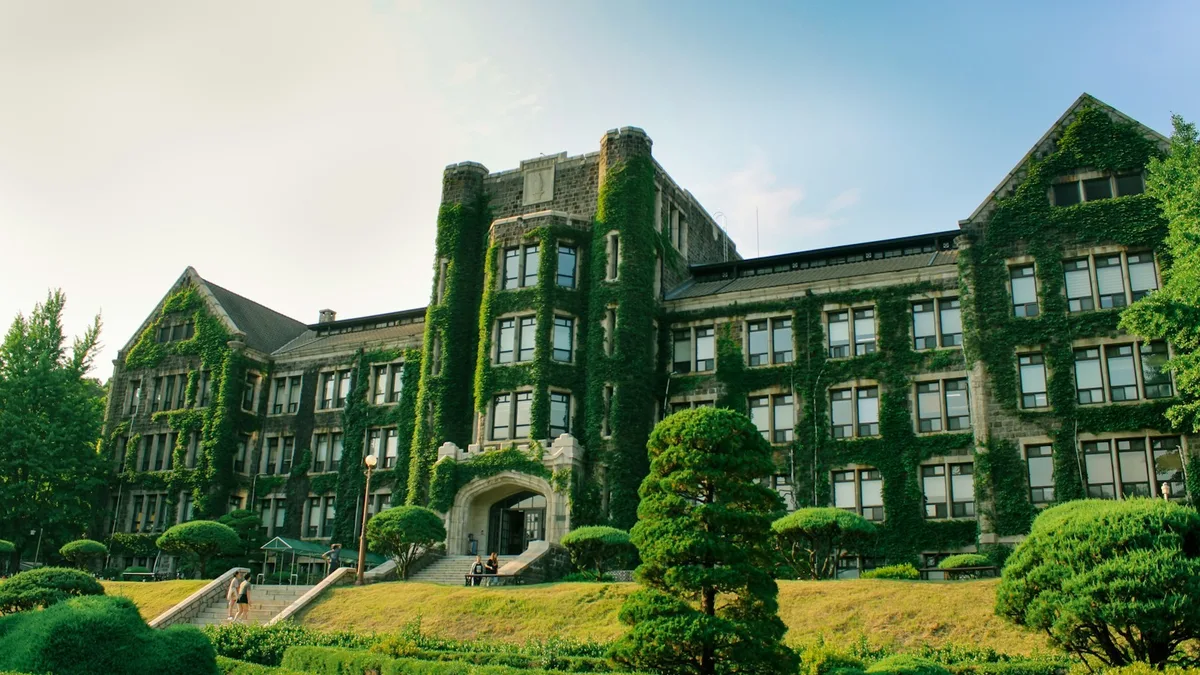
Five Seoul institutes dominate the conversation, and they share a format: 10-week terms, four hours of class a day, five days a week, six levels from absolute beginner to near-fluent. Four intakes a year (spring, summer, fall, winter). It is a genuine full-time commitment — with homework, closer to a job.
As of 2026, tuition per 10-week term runs:
- Yonsei KLI — about ₩1,860,000. The most famous name, a grammar-centric curriculum, excellent TOPIK preparation, huge class availability.
- Sogang KLEC — about ₩1,830,000. The speaking-first program; you talk from day one. Graduates are the confident conversationalists of the bunch.
- SNU (Seoul National University) — about ₩1,590,000, the most affordable of the big names, with a balanced method and the SNU name on your certificate.
- Ewha — about ₩1,710,000. Grammar-and-reading leaning with a slightly gentler curve.
- Korea University — about ₩1,710,000. Balanced curriculum, big pleasant campus.
Add these up honestly: a year (four terms) is ₩6.5–7.5 million in tuition alone, before Seoul rent. This is the expensive road. It is also, by a wide margin, the fastest — full-time students routinely go from zero to holding real conversations in under a year.
The visa is the other half of the deal. Enroll and pay for two or more consecutive terms (20+ weeks) and the university sponsors a D-4 trainee visa — your legal basis for actually living here, getting an ARC, a bank account and a real phone plan. A single term can often be done on visa-free entry if your nationality allows; anything longer needs the D-4. Note that D-4 students face attendance requirements — skip too many classes and your visa renewal gets awkward — and part-time work is allowed only with a permit and usually only after your first six months (the rules).
Which one to pick? Match the method to your goal. Aiming at TOPIK and eventually a degree here: Yonsei or SNU. Want to speak: Sogang. Want the balanced default: SNU, which is also the price pick. In truth, your classmates and your own consistency matter more than the badge — nobody has ever failed to learn Korean because they chose Ewha over Yonsei.

The hagwon road: flexible and half the price
Private language hagwons cluster in Gangnam and Hongdae, and universities aside, this is where Koreans themselves learn their foreign languages, so the industry is mature. Group classes typically run a few hundred thousand won per month for a few sessions a week — roughly half the per-hour cost of university programs, with a tenth of the commitment.
What you gain: schedule flexibility (evening and weekend classes exist), smaller commitments, faster enrollment, often more conversational focus. What you lose: the intensity that makes immersion work, the university certificate, and — decisively for many readers — the visa. Hagwons essentially never sponsor D-4s. A hagwon is the right answer if you're already in Korea on another status: a working holiday, a digital nomad visa, a working E visa, or a spouse visa.
There's also the third road nobody budgets for: language exchange meetups, tutoring apps, and the free or near-free classes some district offices and community centers run. Slower, sociable, and an excellent supplement — just not a structure that gets anyone to fluency alone.
The honest decision table
Choose a university program if: you want to live in Korea for the language, need the D-4 visa to do it, can afford roughly ₩10 million+ for a year all-in, and thrive with structure. This is the road to TOPIK 4+ and everything it unlocks — university admission, better jobs, stronger visa points.
Choose a hagwon if: you're already here on another visa, you're working or traveling alongside study, or you want to test your commitment for three months before betting a year on it.
Whichever you choose: show up daily, and get your survival phrases running early — our Korean phrases guide covers the first week's worth, and understanding Korean age and honorifics will make your classroom Korean land much better in the wild. The classroom teaches you the language; the convenience store, the food ordering, and your new friends teach you the country.
Cover photo by Janet Ganbold, used under the Unsplash License. In-article photo by Julio Lopez, used under the Unsplash License.
Frequently asked questions
›Which Korean language school is best for speaking skills?
Sogang's reputation for a speaking-first method is deserved — conversation drills start in week one, and its graduates are consistently the most comfortable talkers at each level. Yonsei leans grammar-heavy, which pays off for TOPIK scores and reading but produces slower conversational confidence early on. SNU and Korea University sit in between.
›Can I study at a university language program on a tourist stay?
A single 10-week term often fits inside visa-free entry for eligible nationalities, and schools accept short-stay students. Anything longer than one term requires the D-4 visa, which requires enrolling (and paying) for at least two consecutive terms upfront. Overstaying to finish a level is not a plan — see our visa extension guide before your dates get tight.
›How long does it take to reach conversational Korean in these programs?
Programs run six levels of 10 weeks each. Most students report comfortable daily-life conversation somewhere around the end of level 3 — roughly seven to nine months of full-time study — and TOPIK 4, the threshold that matters for jobs and better part-time work rights, typically after levels 4–5. Full-time immersion is genuinely fast; the same distance via evening classes usually takes two to three times longer.
›Do university language programs include housing?
Not automatically. Some institutes offer limited dormitory spots (roughly ₩500,000–1,500,000 per month depending on school and room type) that fill first-come-first-served well before term starts. Most students arrange their own goshiwon, sharehouse or one-room — budget ₩350,000–800,000 monthly in Seoul and apply for dorms the day applications open if you want one.
Sources and updates
Last edited on October 6, 2026. Sources support the specific details discussed in the guide; check the provider for current prices, availability and eligibility.